
NSC scores high on all three parameters that conservative investors are seeking -- safety, tax-adjusted returns and liquidity.
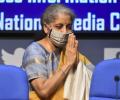
Finance Minister Nirmala Sitharaman on Monday said the government has come out with open and transparent Budget and has not made any attempt to hide anything under the carpet.

Equity investors should thank cash-rich biggies such as TCS, ITC, HUL, Nestl, and Bajaj Auto for this.

Although insurers feel loss ratios in the health segment may get impacted, and profitability will take a hit, capital erosion will not take place, at least for the large entities.

'Stick to FDs of shorter tenures, preferably one-two years.'

Move to increase 90-day window to 120 days to give more time to borrowers to service loans.

Returns in Systematic Transfer Plan are consistent as money invested in debt mutual fund schemes earns interest till the time the whole amount is fully transferred to equity fund, says Vishwajeet Parashar, Sr VP and Group Head -- Marketing, Bajaj Capital

All Sensex components ended in the red. SBI was the top loser, followed by ONGC, Axis Bank, ITC, Titan, Bajaj Auto, TCS and IndusInd Bank.

Market-linked products have been driving the growth of private insurers for some time now. But, the market volatility has forced the companies to re-think their strategies, reports Subrata Panda.

Even if you get a bit late in buying things you need, it is always better to avoid debt traps, advises Vishwajeet parashar
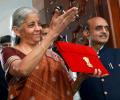
At the customary post-Budget media interactions, Finance Minister Nirmala Sitharaman and her topmost bureaucrats touched upon a number of issues. The minister said the government taxing income from digital virtual assets did not give them legitimacy and that issue was being dealt separately in the planned cryptocurrency Bill. She also expressed confidence that the Budget targets were achievable.

'We never go overboard on any stock, no matter how good it may seem.'

Banks make loans available at lower rates to attract high networth customers

Top losers in the Sensex pack on Friday included Bajaj Finance, ONGC, IndusInd Bank, PowerGrid, L&T, Axis Bank, NTPC, Bharti Airtel, HDFC, HDFC Bank and Kotak Mahindra Bank, falling up to 2.08 per cent.

ONGC was the top gainer in the Sensex pack, rallying around 6 per cent, followed by IndusInd Bank, L&T, UltraTech Cement, Titan, SBI and NTPC. NSE Nifty settled 32.10 points up at 14,707.80.

This month, advertisements for managing directors and the senior management team for the National Bank for Financing Infrastructure and Development or NaBFID, should be out, signalling the start of a financial institution (FI) like no other the country has ever had. For this and other reasons government managers associated with the NaBFID project are convinced it should remain a 100 per cent government-owned entity. This is somewhat different from what former economic affairs secretary Tarun Bajaj said when the NaBFID Bill was being tabled in Parliament earlier this year: "To begin with, it will be 100 per cent government owned.

Investors in the 10% and 20% slabs can get better post-tax returns compared to a bank fixed deposit

Bajaj Finance was the biggest loser in the Sensex pack, tanking up to 8 per cent, followed by Hero MotoCorp, IndusInd Bank, Maruti and HCL Tech. Axis Bank, ITC, NTPC and M&M were among the top gainers.

Consumer businesses come to the rescue of large conglomerates in the midst of a meltdown in commodities.
Such products in insurance parlance are called acturial-funded products. The ban would require Aviva Life Insurance to withdraw all its 14 ULIP products, while Bajaj Allianz one of its ULIPs called Capital Unit Gain.

With more and more youngsters preferring to shop online, the credit appetite has surged.

This recognition is a testimony of India's strong belief in promoting entrepreneurship
In a circular dated May 20, Sebi had directed the listed companies to evaluate the impact of Covid-19 on their capital and financial resources, profitability, liquidity position, assets, and ability to service debt. Instead, companies have spoken about the number of plants, warehouses and distribution centres that have resumed operations; work-from-home and safety measures undertaken for employees; and the labour shortage they are facing.

The broader NSE Nifty, on the other hand, ended 2.70 points, or 0.02 per cent, lower at 11,555.90 in its third straight day of losses.

'If we wait to invest only after the economy recovers fully, it might be too late,' advises Vivek Jain, business unit head-investments, Policybazaar.com.

In its morning update, the Union health ministry said the total number of positive cases has reached 2,16,919 with a record spike of 9,304 new cases since Wednesday 8 am across the country, while the death toll has increased to 6,075 with 260 more fatalities in this period. A PTI tally of figures announced by different states and union territories, as of 9.50 pm, showed a higher number of confirmed cases across the country at 2,17,389 and the death toll at 6,233.

Access to capital for sub-standard companies is on the decline

Twenty years after India's insurance sector was opened up, unshackling the control of state-owned companies, as many as 50 private players have set up shop. Along with their foreign partners, private players have brought about a sea change in the product offering, distribution and underwriting processes, and services levels. Yet, India's insurance penetration needle has not moved much.

As of March 25, life insurers have paid Rs 1,986 crore towards 25,500 Covid death claims

The Reserve Bank of India's (RBI's) move to ban Mastercard from issuing new cards for not complying with the local data storage guidelines may hit five private banks, a non-bank lender, and a major card-issuing company. The impact is expected to be felt for a few months as these players transition to other card networks. According to Nomura Research, RBL Bank, YES Bank, and Bajaj Finserv are the ones most impacted by the ban as all their credit card schemes are allied to Mastercard. Among others, IndusInd Bank, Axis Bank and ICICI Bank have 35-40 per cent of their credit card schemes tied to Mastercard, the report said.

Tata Motors was the biggest loser in the Sensex pack, tumbling 2.47 per cent, followed by Reliance Industries (2.44 per cent), Maruti (1.84 per cent), SBI (1.76 per cent) and Bajaj Finance (1.23 per cent).

Major gainers in the Sensex pack were Hero Motocorp, which rallied 7.01 per cent, followed by Bharti Airtel (6.69 per cent), Yes Bank (5.30 per cent), Adani Ports (4.90 per cent), Tata Steel (3.75 per cent) and Bajaj Auto (3.70 per cent).

Byju's, says Anita Kishore, has given the founders of the businesses it has acquired the independence to operate separately and maintain their core culture.

Ajit Mishra, vice president, research, Religare Broking, answers your queries.

Ajit Mishra, vice president, Research, Religare Broking, answers your queries.

Ajit Mishra, vice president, Research, Religare Broking, answers your queries.

The FPI holding in India's top 100 companies, which are part of the Nifty 100 index, declined to 24.23 per cent on average at the end of March this year, from a high of 27.5 per cent at the end of March 2021. This is the lowest FPI holdings in India's top listed companies in at least three years. A general sell-off by FPIs has weighed on stock prices and the benchmark S&P BSE Sensex is down 8.5 per cent, from its 52-week high made in October 2021. Most analysts expect FPI flows to remain weak in FY23 as well, given rising bond yields in the US and an expected earnings slowdown in India due to high inflation and commodity prices.

The $306-million investment in Ola Electric Mobility by SoftBank Corp, Arun Sarin Family, Ratan Tata and Matrix has been the biggest funding in this space in value terms this year.

Corporate revenues will decline for a third consecutive quarter in March on a YoY basis - one of the worst shows by these companies in many years.

The fund house says it is doing this to protect the interests of existing investors.
